Nonprofits and churches exist to serve people. That work depends on trust, communication, and the ability to respond. But when systems go down, even just for a short time, the impact can be devastating, and IT recovery without assistance can feel like an impossible task.
According to the 2025 State of Resilience survey, organizations face an average of 86 outages per year. With 84% of respondents reporting a revenue loss of at least $10,000 during EACH incident, and that’s just the monetary loss. Paused donations, canceled events, and staff scrambling to adapt. Short interruptions turn into costly setbacks on all fronts.
Still, many mission-based groups don’t have a clear plan for when trouble strikes. That’s where business continuity consulting services offer real help. Planning helps protect not just your systems, but your team’s energy and your public credibility. With the right strategy and support, your team can keep serving even under pressure.
This guide gives you a practical starting point to spot weak spots, strengthen your response, and lead confidently on continuity.

The High Cost of Downtime
Interruptions don’t just slow things down. They put your mission at risk. For nonprofits and churches, even brief downtime can create ripple effects that take weeks or even months to fully recover from.
Many organizations don’t realize how dependent they are on digital tools and basic infrastructure until something fails. Without a clear plan in place, each hour lost compounds pressure on your staff, volunteers, and the people you serve.
Here are some examples of how downtime can affect your organization:
1. Disrupted Community Programs
A storm or cyberattack can delay after-school tutoring, meal deliveries, or counseling sessions. These are time-sensitive efforts that many families depend on week to week.
2. Lost Donor Records
If donor databases become inaccessible, it’s hard to manage gifts, track pledges, or run campaigns. That creates fundraising setbacks and limits your ability to follow up with supporters.
3. Event Cancellations
Church services, community outreach days, or fundraising events often rely on technology for coordination. Without access to communication tools or booking systems, these gatherings may be canceled or poorly attended.
4. Staff Burnout
Repeated tech failures wear down morale. Staff who constantly troubleshoot instead of focusing on their roles can become disengaged or overwhelmed.
5. Communication Breakdowns
When email, phones, or messaging systems go offline, it’s harder to coordinate internally or respond to community needs. Miscommunication can delay services and damage relationships.
6. Delayed Grant Reporting
Many funders require strict reporting timelines and documentation. Losing access to reports or financial systems can cause you to miss deadlines and risk future funding.
7. Security Risks
Interruptions often expose security vulnerabilities. In the rush to restore services, organizations may skip basic checks, leaving them open to further risk.
8. Confusion Among Volunteers
Without clear communication, volunteers may not know when or where to show up. That leads to lower turnout, missed responsibilities, and frustration on all sides.
Continuity isn’t only about keeping servers running; it’s about protecting your organization’s ability to be present when it matters most. That’s why continuity consulting isn’t just a nice-to-have; it’s a way to lead with clarity and responsibility, even in uncertain conditions.
No organization is immune to interruptions, of course. But with business continuity planning, every organization can prepare for them.

Building a Plan That Fits Your Values and Budget
A business continuity plan isn’t just about technology either. It’s about making sure your team can continue serving, even when the usual tools aren’t available. The goal is to reduce the chaos during a disruption and help everyone stay focused on what matters most. When built thoughtfully, a continuity plan becomes a steadying force and a way to act proactively.
A basic continuity plan should cover the following:
1. An Inventory of Systems and Data
Start by listing the systems you rely on daily. That might include donor databases, accounting tools, email, phones, file storage, calendars, communication tools, and facility access systems. Then ask: if this system went down today, what would we lose?
Knowing what you use regularly helps you prioritize what to protect and what to back up. Include both digital systems and manual processes in your inventory.
2. A Risk Assessment
Look at your location, tech setup, and common threats. Are you in a flood-prone area? Have you had phishing attempts lately? What happens if someone accidentally deletes a shared file or misplaces a hard drive?
It’s helpful to think through both external risks (like storms or cyberattacks) and internal risks (like user error or outdated software). Consider how your organization would respond to both.
3. Backup Processes
Where is your data stored? How often is it backed up? Is the backup automatic or manual? Do you have cloud access to files if your local server fails? Can you retrieve a backup quickly if needed?
A good backup process doesn’t just copy files. It ensures you can recover them without delay. Make sure your backups are secure, consistent, and tested.
4. Communication Plans
If a crisis happens, how do you inform your team? Who notifies your board? What do you say to donors or the community? A clear communication plan avoids confusion and reduces stress.
Draft message templates in advance for different scenarios: service disruptions, data breaches, event cancellations. Include preferred communication channels (email, phone trees, text alerts).
5. Recovery Steps and Assigned Roles
If something breaks, who fixes it? Who makes decisions? Document your recovery process in simple steps. Assign specific roles, even if you have a small team.
Map out a step-by-step response for your most likely disruptions. Include clear roles: someone to lead communication, someone to handle technical recovery, and someone to manage logistics.
6. Testing and Updates
A plan is only useful if it works. Set a schedule to test your backup system, walk through your communication steps, and update your documents.
Hold a short annual tabletop exercise. This helps your team understand their roles and identify areas for improvement.
Before You Plan, Know Where You Stand
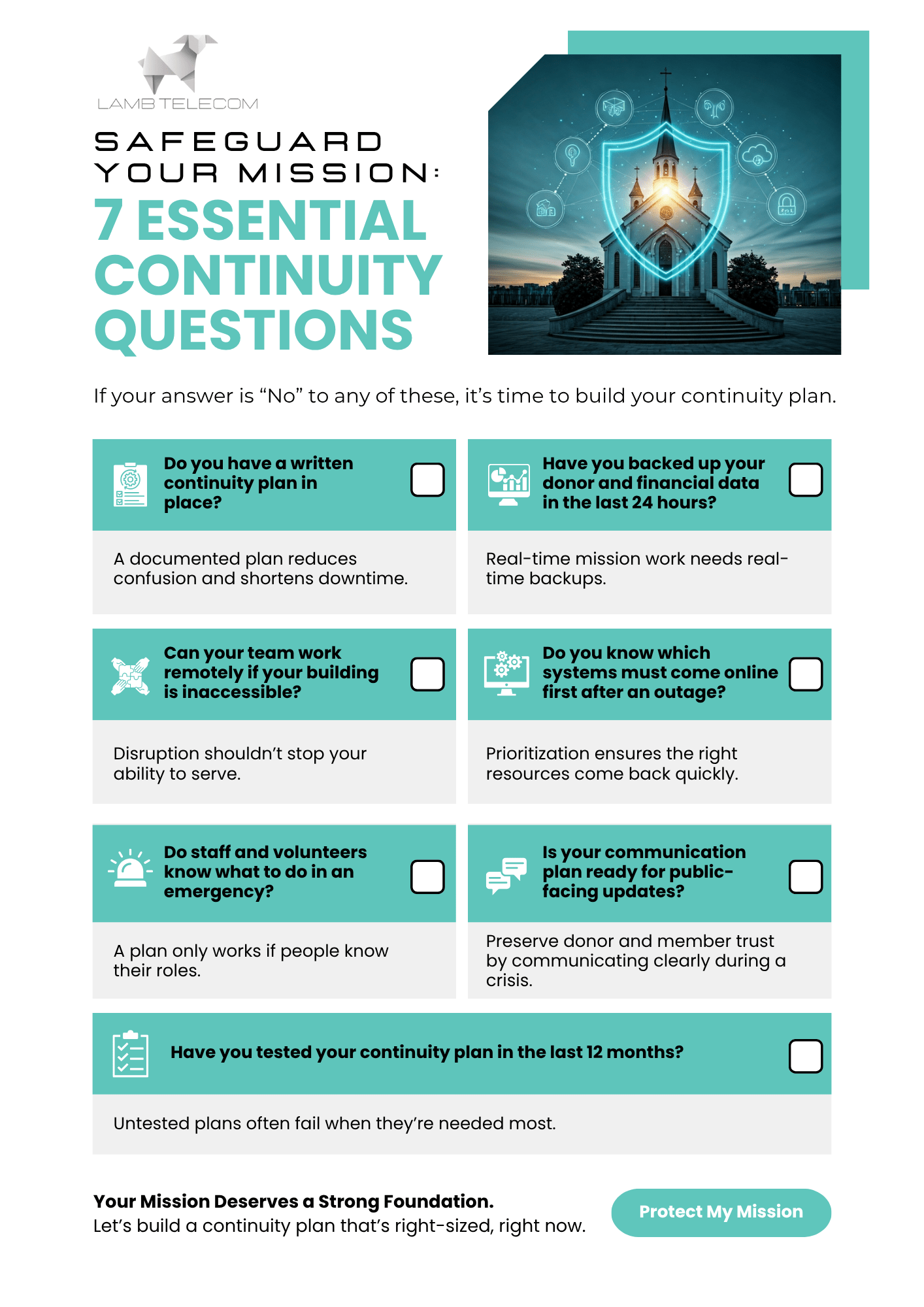
Continuity planning is more than a checklist; it’s an ongoing effort. You don’t need a complex plan to start making progress, just clarity on where your gaps are. Use the questions below as a gut check. A few honest answers can show you exactly where to focus next.
Get the Right Support Without Overstretching Your Team
Even with the best intentions, building and maintaining a business continuity plan can feel like a heavy lift. Many nonprofit and church IT teams are already stretched thin with limited staff and resources. Having external support, especially from partners who understand your environment, can make all the difference.
Business continuity consulting services can help you:
- Identify specific risks tied to your mission, community, and infrastructure
- Evaluate your current systems for weaknesses in backup and recovery
- Build a plan that fits your real-world capacity, not an ideal scenario
- Establish processes for responding to common disruption types
- Map out a communication flow that works with your team structure
- Review and improve your backup strategy so it’s actually usable under pressure
- Facilitate testing to make sure your plan works in practice, not just on paper
- Train your staff and volunteers on what to do during an outage or cyber incident
At Lamb Telecom, our support starts with listening. We’re not here to push services because you already know what your mission needs. We help you create a plan that’s manageable, meaningful, and matched to your pace. Our role is to advise, connect, and clear the path so you can focus on impact.
Here’s how we approach continuity support:
- Conduct a discovery session to understand your operations and constraints
- Audit your current infrastructure, tools, and communication flow
- Highlight top-priority risks based on your organization’s daily work
- Develop a simple, step-by-step continuity roadmap
- Recommend trusted tools and providers that fit nonprofit budgets
- Ensure backup systems are accessible and tested regularly
- Guide your team through plan walkthroughs and role assignments
- Provide ongoing check-ins to adjust as your needs evolve
Continuity planning doesn’t have to be overwhelming or expensive. With the right partner, you can build resilience without derailing your existing work. The goal is peace of mind, not more complexity.

Make Continuity Planning Part of Your Mission Strategy
A strong continuity plan doesn’t just support operations. It reinforces your mission. It shows your team, board, and community that you take your responsibilities seriously, even behind the scenes. You don’t need to predict every possible crisis. But you do need to be ready for the most likely ones.
That kind of readiness builds trust not just in your programs, but in your leadership. It also saves time, energy, and resources when things don’t go as expected. Maybe it’s about time to ask the hard questions: What would happen if your systems went down tomorrow? Who would respond? What would be at risk? If you’re unsure, that’s the best reason to act now.
Schedule a free continuity consultation with our experts. We’ll help you lay the groundwork for a plan that works with your mission.